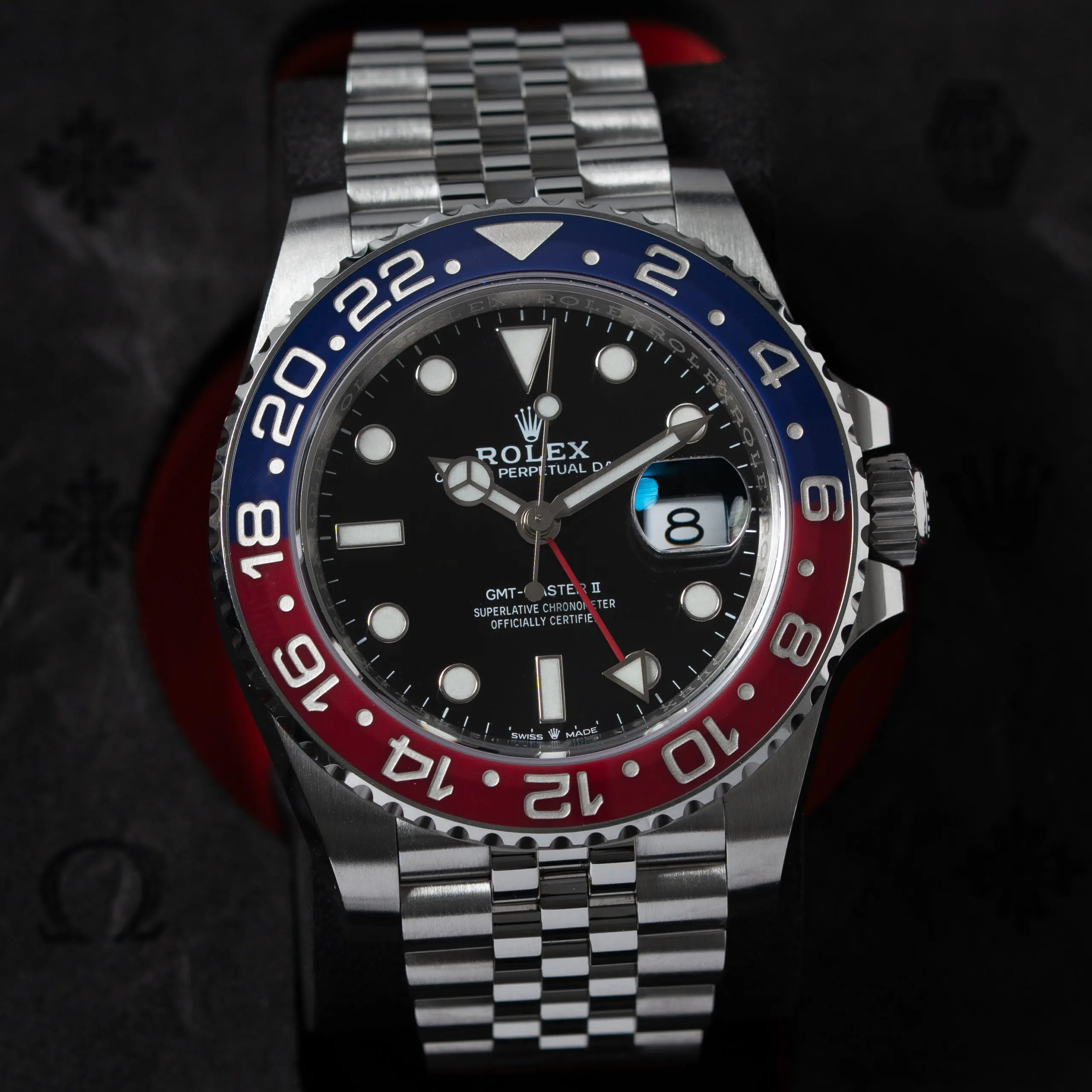
Rolex GMT-Master II Price Outlook Heading Into 2026–2027
The Rolex GMT-Master II has long operated as one of the most liquid and globally recognized sports Rolex references. As we move toward 2027, pricing behavior across Pepsi, Batman, Sprite, and Root Beer variants is revealing early signals about supply normalization, collector rotation, and secondary market resilience.
Retail routing often matters more than headline production.
Pepsi, Batman, and Sprite do not move in lockstep.
GMT tends to hold tighter spreads than many steel references.
Post-2022 normalization supports a healthier base into 2027.
Macro Market Positioning
Within the modern Rolex sports catalog, the GMT-Master II occupies a unique intersection of travel utility, heritage design, and collectible bezel variation. Unlike the Submariner, which operates as a pure dive reference, GMT models benefit from multi-timezone functionality while retaining everyday wearability.
Many buyers view GMT references as “cross-category” assets — blending tool-watch credibility with collector-driven variation.
As broader luxury markets stabilized through 2025–2026, GMT pricing often showed less downside volatility than more hype-driven categories. This resilience reinforces its positioning as a core steel hold rather than a trend-dependent spike asset.
Supply vs Allocation Shifts
Authorized dealer allocation continues to dictate GMT price behavior more than raw production volume. Even as Rolex incrementally expands capacity, Pepsi and Batman deliveries often remain structurally constrained at the retail level.
Allocation “tightness” is best measured by delivery consistency and conversion outcomes, not just waitlist length.
Buyers tracking forward pricing trends should contextualize GMT supply inside the broader Rolex forecast framework. Our Rolex price forecast for 2026–27 breaks down how routing discipline can influence secondary premiums more than headline unit growth.
Model-Specific Performance
Not all GMT references are moving in lockstep. Pepsi continues to command the strongest recognition premium, supported by its heritage colorway and persistent Jubilee bracelet demand.
Coverage from Hodinkee has discussed how legacy bezel configurations can retain collector attention through corrections, particularly when narratives tie back to historic travel identity.
Batman and Batgirl references remain highly liquid but can be slightly more sensitive during pullbacks. Meanwhile, the left-handed Sprite has shifted from a novelty premium toward a more normalized trading range, suggesting digestion rather than demand collapse.
Secondary Market Liquidity
One of the GMT-Master II’s strongest investment attributes is transactional liquidity. Many dealers report faster turnover on GMT references than on adjacent lines where buyer pools are narrower.
Liquidity matters because it can reduce exit friction and keep spreads tighter when sentiment cools.
For sellers, this can translate into faster exits. For buyers, it reinforces GMT positioning as a capital-preservation Rolex rather than a purely speculative appreciation play.
2027 Price Forecast
Heading into 2027, GMT-Master II pricing is more likely to follow a stabilization-then-expansion curve than a rapid spike. The correction cycle that began in 2022 reset speculative premiums, creating a healthier base for gradual appreciation.
The most durable drivers tend to be allocation discipline, bezel configuration desirability, and broader luxury confidence.
The most probable scenario sees Pepsi maintaining category leadership, Batman trailing closely in liquidity, and niche variants appreciating selectively depending on production continuity and collector narrative strength.
Will GMT-Master II prices rise again by 2027?
Gradual appreciation is more likely than rapid spikes, supported by allocation control and steady collector demand.
Which GMT model holds value best?
Pepsi references often maintain the strongest premiums due to heritage, recognition, and deep buyer pools.
Is GMT a better hold than Submariner?
GMT models can show very strong liquidity and broad demand, though both remain core steel references with durable buyer bases.